KTM motorcycles are celebrated for their performance, but like any machine, their electrical systems can develop quirks. Turn signal issues are a frequent topic of discussion among KTM owners, ranging from annoying hyperflashing to complete system failures. Understanding the root causes and troubleshooting steps can save you time, money, and frustration, keeping your ride safe and street-legal.
The Infamous Hyperflash
One of the most common complaints is hyperflash—where your indicators flash at double or even triple their normal speed. This issue almost always arises after replacing stock incandescent turn signals with LED units. The bike’s stock flasher relay is designed for the higher electrical resistance of traditional bulbs. LEDs draw significantly less current, and the relay interprets this lower draw as a burnt-out bulb, speeding up the flash rate to alert you . In some cases, replacing the relay with an LED-specific electronic flasher relay offers a simple plug-and-play fix that restores normal timing without needing additional components . Alternatively, wiring load resistors in parallel with each new indicator can mimic the electrical load of the old bulbs. For some KTM models, simply starting the engine can also resolve the issue, as the increased system voltage from a running alternator may bring the flash rate back to normal .
Complete Turn Signal Failure
A more serious problem occurs when an entire side of turn signals stops working. One KTM Duke 390 owner reported that the entire right side (both front and rear) was dead while the left side functioned perfectly . Since LEDs don’t have filaments to burn out, the culprit is often elsewhere. The bike’s electrical system may detect a fault—such as a short circuit or incorrect resistance—and cut power to that circuit to protect itself . Following the wiring from the indicators to the main harness can help identify breaks, corrosion, or loose connections. KTM uses dedicated front and rear turn signal wiring harnesses that connect to the main electrical system, and these connectors are a common failure point . Using a multimeter to test for voltage at the switch and along the circuit is the most reliable way to pinpoint the problem. In some instances, the turn signal switch itself may be faulty and require replacement or repair .
Intermittent and Mechanical Issues
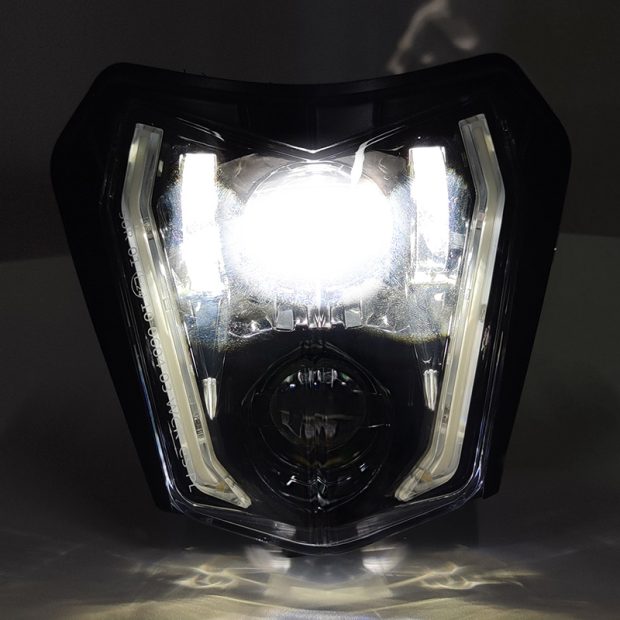
Sometimes, turn signals work unpredictably. A KTM Duke 125 owner described a baffling issue where signals would not work at all on a cold start but would function after riding for ten minutes and restarting the bike . This can point to the bike’s “integral unit”—the central electronic module that controls various functions, including turn signals. On older models, a failing integral unit can cause such intermittent behavior . More straightforward mechanical problems also occur. If a turn signal becomes loose or floppy, it can often be tightened by accessing the mounting nut inside the fairing. This may require removing bodywork or even tilting the KTM led headlight assembly forward to reach the small nut that secures the indicator in place .
A Note on Headlights and Overall Lighting Balance
While troubleshooting your turn signals, it’s worth taking a holistic look at your KTM’s entire lighting system. A faulty turn signal circuit can occasionally be linked to broader electrical gremlins, including those affecting the headlight. Some KTM models require you to flip the headlight forward to access turn signal connectors or mounting hardware for inspection . Moreover, maintaining consistent and powerful lighting across all your bike’s bulbs—headlight included—is crucial for safety and a cohesive, modern look. Upgrading a dim headlight to a modern LED unit, paired with your repaired or upgraded indicators, significantly enhances your nighttime visibility and overall presence on the road. The principles of diagnosing electrical faults, such as checking connectors and voltage, apply equally to your headlight and turn signal circuits, making it a worthwhile system to inspect thoroughly.